Giving Back!

Giving Back!

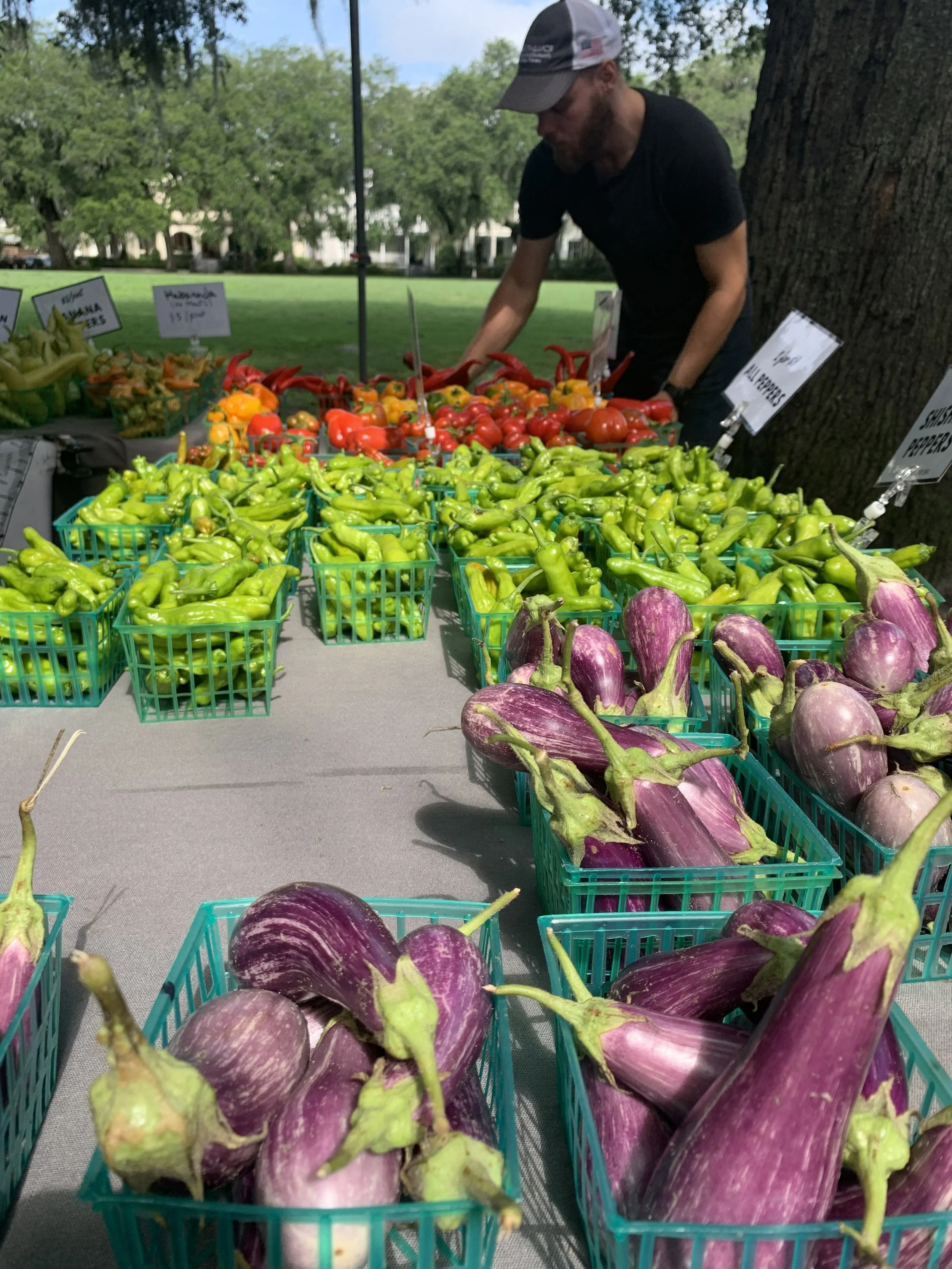
Because of our commitment, we are reinvesting a portion of every dollar we earn back into our local food communities in a two-part process: buying food from local growers and putting that food on the tables of those in need. We believe this is a practical solution to two key problems within our local systems.


Food and Family

2022 was the last Thanksgiving I spent with my dad. I knew it would be. He had been fighting cancer for about five years and that summer, he decided he was done fighting it. 

"No more chemo!" is often the chant of those who are victorious, but it's also the resigned sigh of those who have simply had enough. 

But this is not a post about cancer, or death, or dying … oddly enough, it's a post about food!

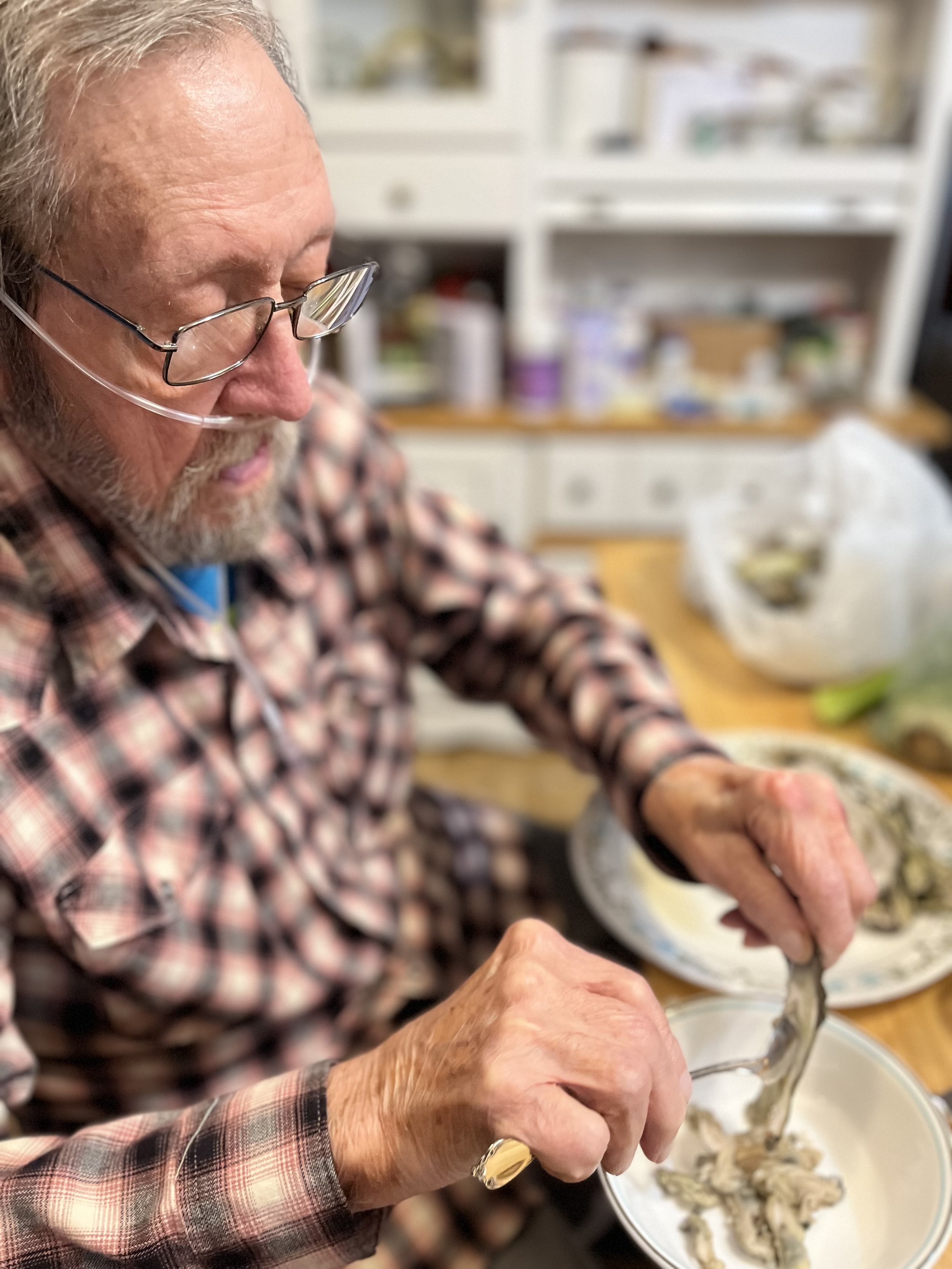
My Dad shucking oysters for Thanksgiving dressing.

I have a deep love of food and I inherited that, in part, from my father. It's not just about eating food - how it tastes and smells and makes us feel - it's also about making that food, and all the memories and emotions that are tied up with it. 

Dad had, by all accounts, an idyllic childhood; growing up in Elkin, North Carolina in the 40's and 50's. His family was not wealthy by any means, but they also did not go without. His mother always planted a large garden, she kept chickens (which she would kill and clean for cooking), the family would forage together certain times of year, and a farmer friend would bring by produce and meat throughout the seasons.

Dad would tell stories of eagerly being his mother's "helper" in the kitchen because it meant that he got lots of samples and could lick the batter from the spoon … a tradition I gladly carry on! But I think it went a bit deeper than that. Dad was clearly his mama's boy! He once saved up enough money to buy her her very first electric mixer - no small feat at that time!

So, as the holidays approached, I began to prepare myself, both mentally and emotionally for this last Thanksgiving and Christmas with my Dad. And, of course, my mind went to food. What were the foods that he talked about having during those times that were not necessarily included in our usual family fare?

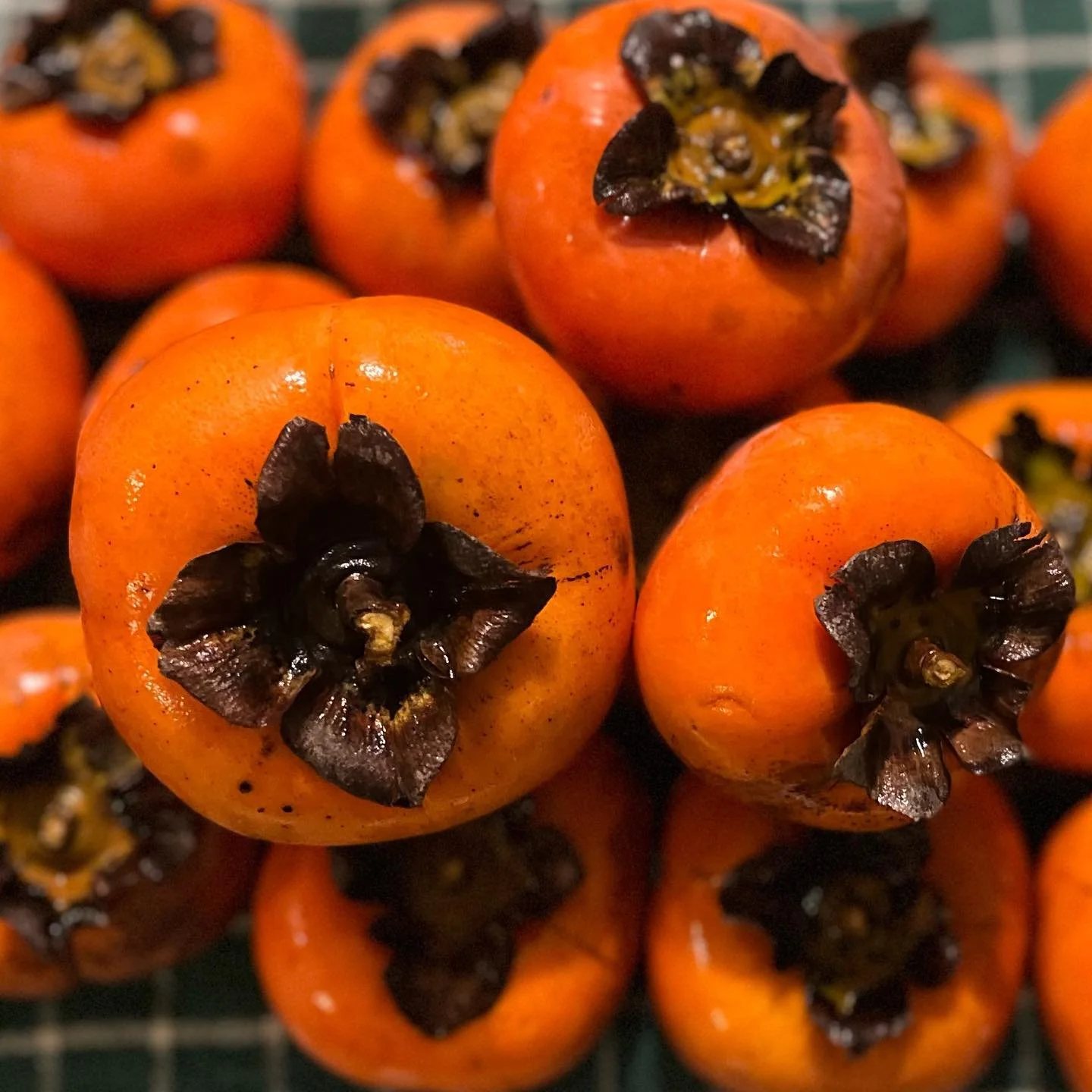
Persimmons

The two that came to mind were oyster dressing and persimmon pie. 

Not surprisingly, these dishes feature two crops that are in season during the fall and were likely a staple on many holiday plates when people were more closely connected to the seasons' rhythms and profferings.

I wish I could say that I made them both for him that year. But I never did get around to making that persimmon pie even though I did make the effort to actually procure the persimmons themselves.

But we did make the oyster dressing! He sat in the kitchen with me and we shucked the oysters together, talking of days gone by.

The story, happily, doesn't end there, because life isn't just about endings but new beginnings. Just recently, I had the opportunity to share one of my Dad's favorite food traditions with two more generations! 

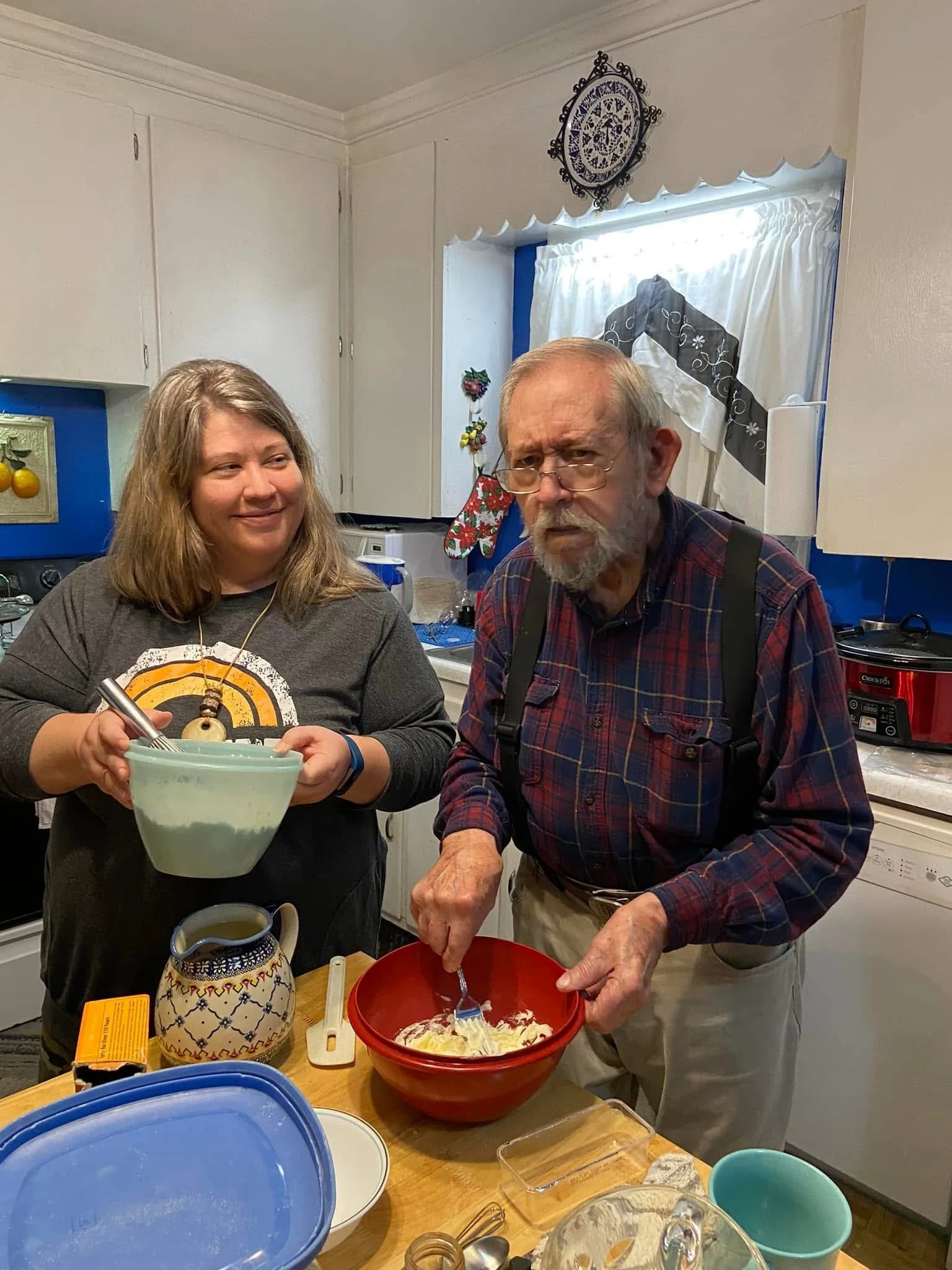
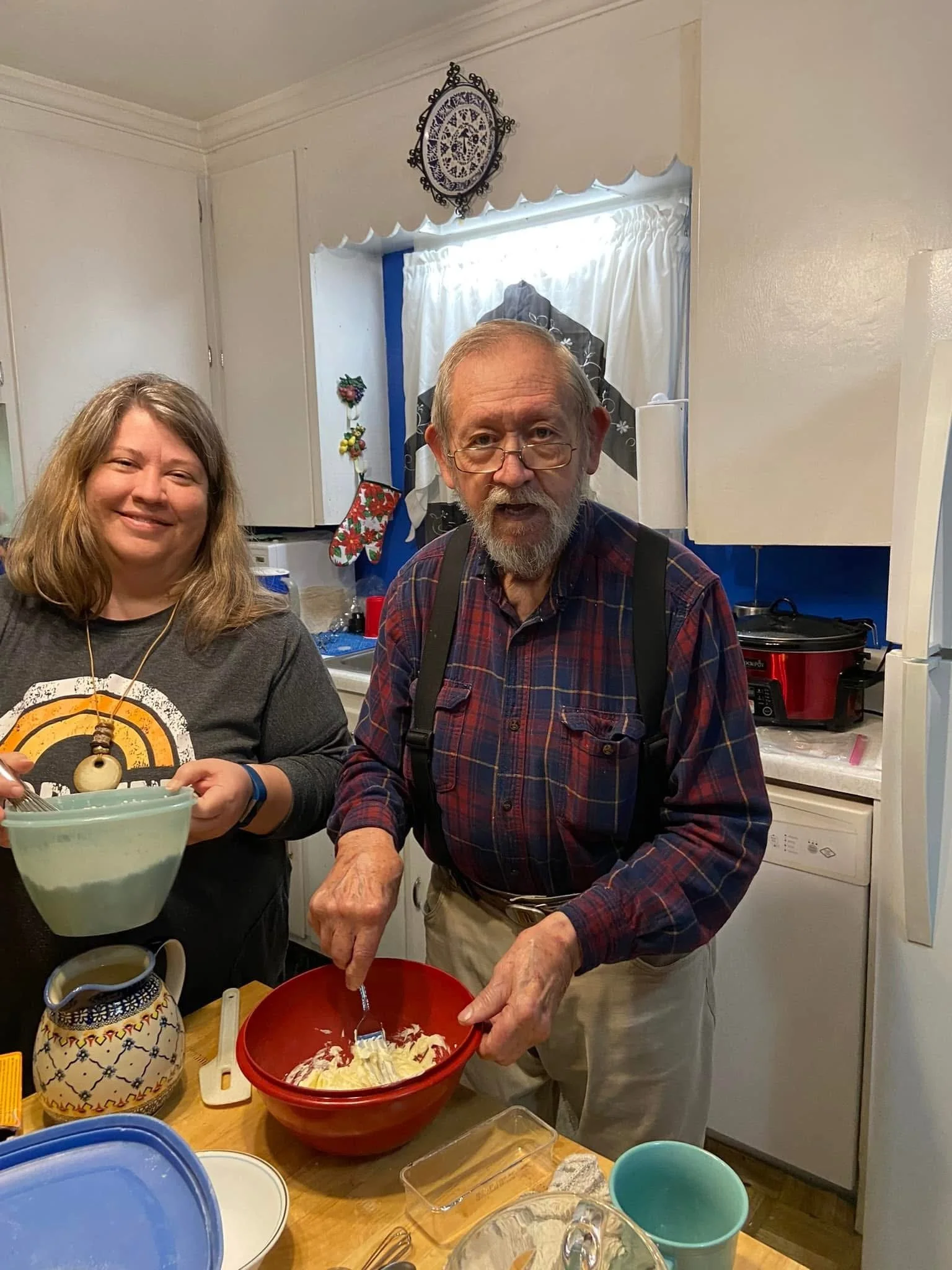
Dad’s scowly face. I believe this was the last time we snickered together while baking the doodles.

Snickerdoodles were one of my Dad's favorite cookies and he had fond memories of his mother baking them around the holidays and storing them in empty potato chip tins (apparently, chips used to come in tins). 

When we were kids, Dad would bake snickerdoodles for road trips and school events. He would carefully measure every ingredient, make each cookie the exact same size, and once cooled, would neatly stack them, count them and place them in tins (he was maybe slightly just a little OCD about it). 

I can remember sneaking into the kitchen and nicking a carefully formed ball of dough, neatly coated in cinnamon and sugar, sitting on a cookie sheet waiting for its identical dough balls to join it before heading into the oven. When he would notice… which of course he did.. I'd get a scowl and probably be told to get out of the kitchen and leave his cookies alone! 

Proof that my Dad wasn’t the grumpy curmudgeon I may have inadvertently made him out to be. Scowly, grumpy, yelling … it was kind of our love language in the kitchen.

Although he took his baking very seriously, he always made sure to add plenty of the secret Tatum family ingredient… lots of snickering (this is a trademark combination of smartassery and laughing). 

If there was one cookie to sum up the Tatum family experience, it would be the snickerdoodle.

As an adult, Dad and I spent many an hour baking snickerdoodles together over the years. Well, I say together, but Dad's very particularness when it came to baking and my very…. Um… not so particularness …. meant that usually either I baked snickerdoodles while he hung out with me or he baked them while I hung out with him. 

I'd get fussed at for using the wrong bowl, not measuring the cinnamon and sugar, actually using a mixer instead of just a wooden spoon…

But I loved those moments and in the end, we always laughed and enjoyed some really good cookies.

Recently, I got to share the tradition with my great niece! 

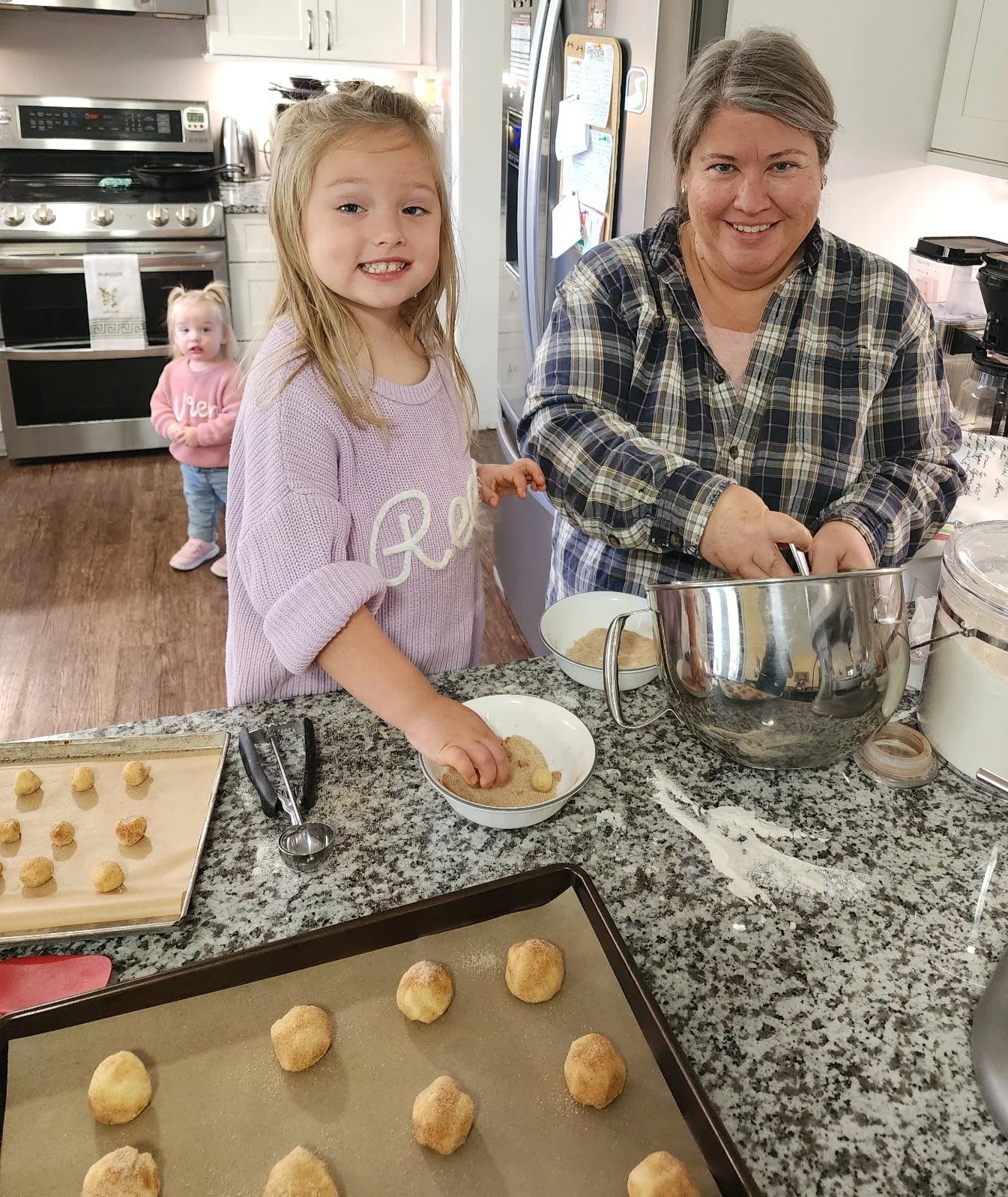
My great niece and 5th generation snickerdoodler, Reece, learning from the best!

Wearing one of my Dad's old flannel shirts, I made snickerdoodles my way and shared the experience of mostly measuring ingredients and dumping them into the mixing bowl, forming some very irregular balls of dough, rolling them into a mix of cinnamon of sugar whose ratios were decided by taste and not teaspoons, and then popping the occasional deliciously coated raw dough ball into our mouths before continuing the process.

Most importantly, we both contributed heaps of the main ingredient… plenty of snickering!

It's an experience I hope to repeat again and again and again when little sister (i.e. the cutest photobomber ever) is big enough to participate.

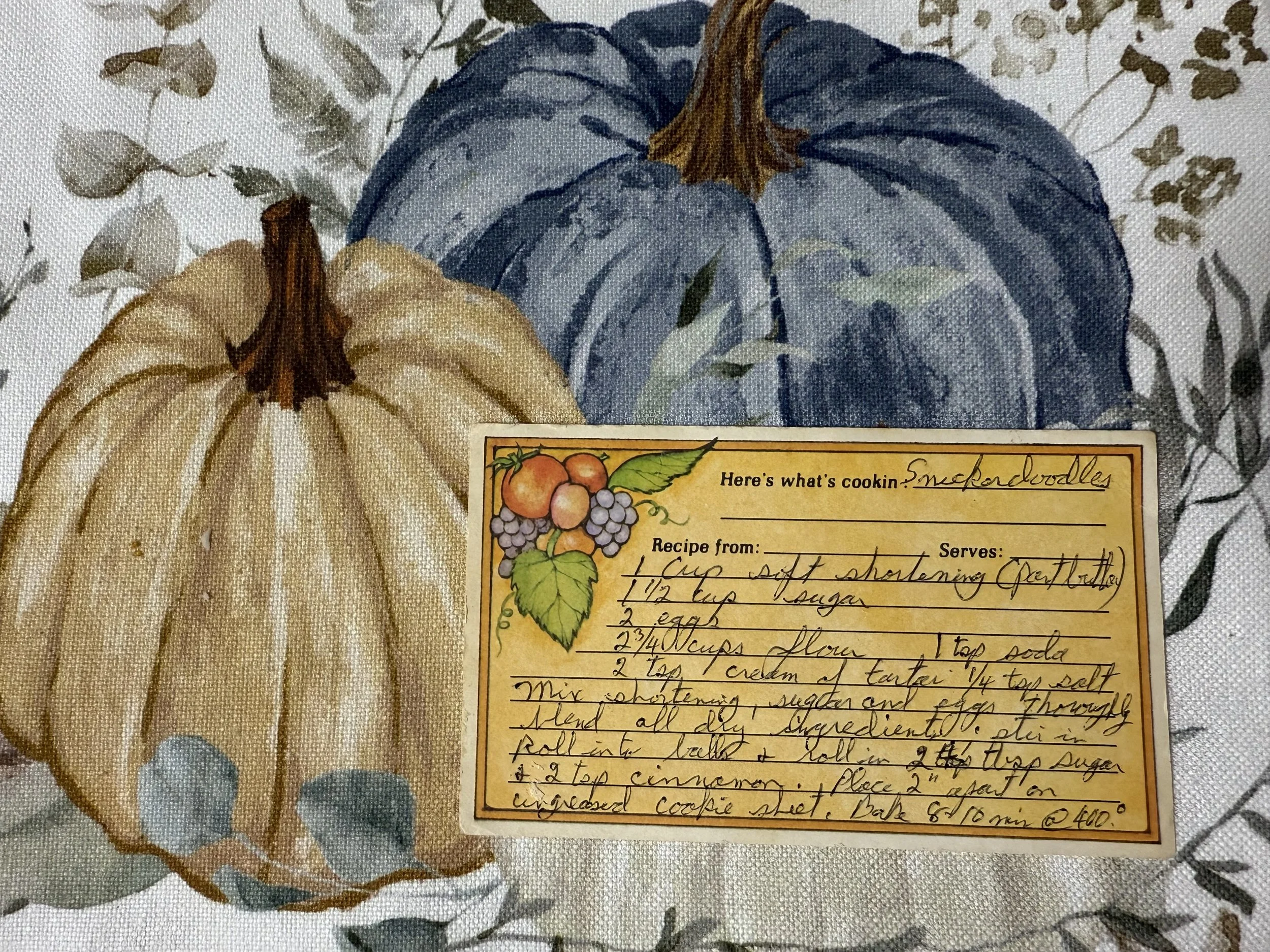
Dad’s snickerdoodle recipe minus the secret ingredient… if you can read his handwriting, try making some with your family this holiday season and maybe start a new tradition of your own … from our family to yours!

Welcoming Our Newest Team Member!


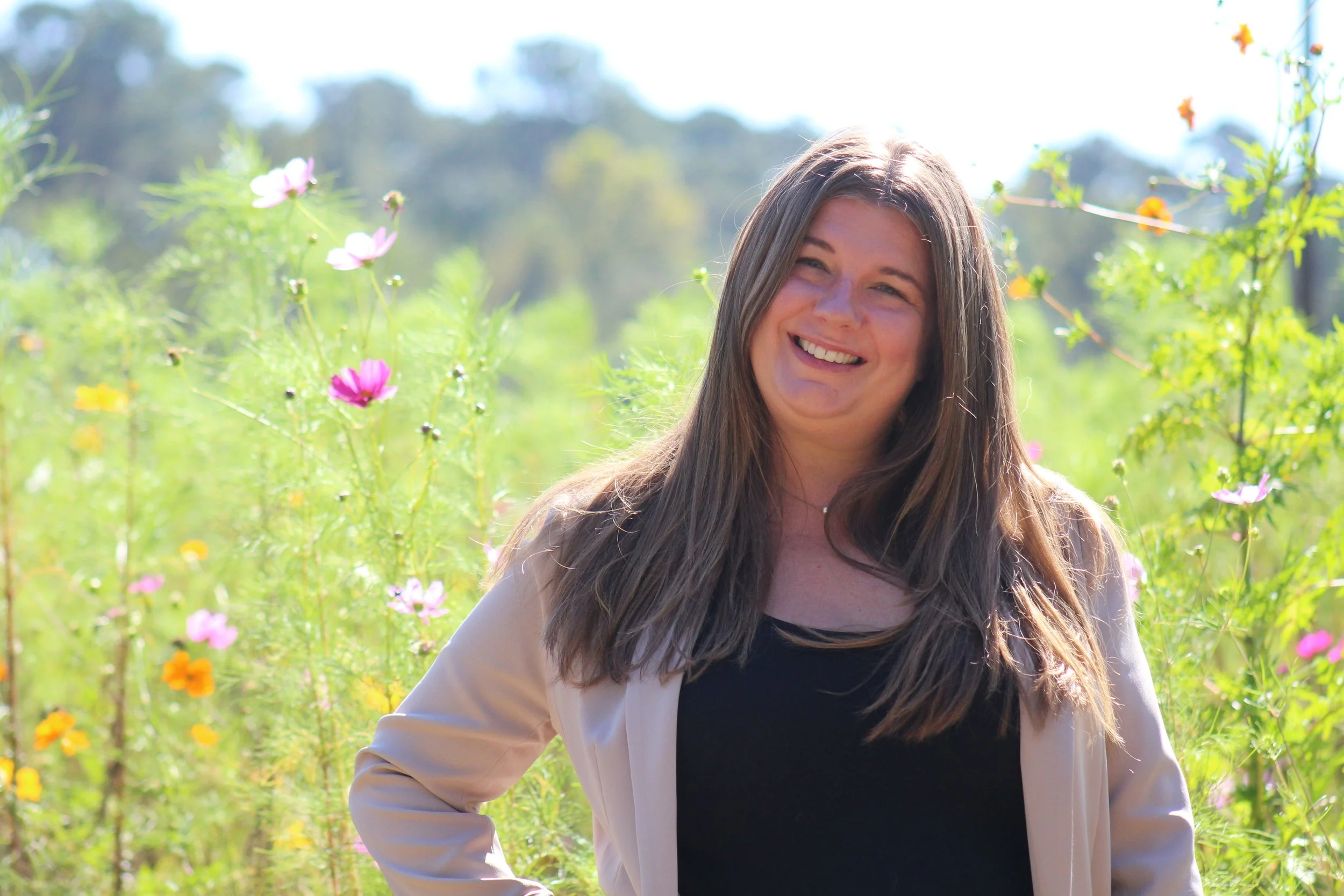
I am so excited about the relaunch of Southern Soil and that excitement is due, in large part, to our newest team member, Kelly Morris! Kelly is taking on the role of our newly established Director of Development and Engagement.

Kelly Morris at her Bloom (Where You’re Planted) Flower Farm in Garden City

Kelly’s career spans the tri-sector—nonprofit, public, and private—where she has worked to build collaborative partnerships, strengthen community engagement, and drive strategic growth initiatives. As a small business owner herself - Kelly and her husband Andrew are the owners of Savannah Hydroponics & Organics - Kelly has a strong understanding and passion for local communities, especially as related to food-centric enterprises.


She combines her business expertise with a deep-rooted food philosophy: that food is not just sustenance, but a powerful connector capable of bringing people together, fostering shared experiences, and strengthening communities. This belief is perfectly aligned with Southern Soil’s mission to create meaningful connections across our local food system.

Kelly will be working closely with local businesses to build mutually beneficial partnerships—helping them reach a wider audience while strengthening the network of small farms, food producers, and entrepreneurs in our region. 

Kelly is a mom of two young boys, she is an avid gardener and cook. She brings a fresh and valuable perspective to Southern Soil. From the start, Kelly has had a strong understanding of the mission and goals of Southern Soil and our working relationship has truly been a joy. It's a rare and beautiful thing when you have the right person in the right job at the right time and I'm looking forward to seeing how we will grow together - as a team, as a business, and as a community of people who want to see positive changes in our local food systems.

Welcome aboard, Kelly! I look forward to accomplishing big things together and having a lot of fun along the way!

LeeAnna Tatum, Founder/Publisher

LeeAnna Tatum, Founder and Publisher of Southern Soil and Kelly Morris, Director of Development and Engagement working hard and having fun!

Let's Move the Conversation Forward

Let's Move the Conversation Forward

I don’t know about you, but more and more often as I’m out and about or just having conversations in general the topic of food is coming up more regularly. Not the typical, “what should we have for dinner?” type conversations, but expressed concerns over food shortages, higher prices and the desire to have more control.

These kind of conversations are a perfect gateway to further the discussion of local food systems and the importance of finding local food suppliers and learning to grow more of our own foods too!

Community Supporter: Brighter Day and The Sentient Bean

Community Supporter: Brighter Day and The Sentient Bean

Cornering the market on fresh food done well in historic downtown Savannah, these two establishments serve up more than great food!

The Sentient Bean has been brewing up coffee and community since 2001 under the leadership of Kristin Russell. The Bean’s own brand of activism and outreach goes hand in hand with a fresh, locally sourced, vegetarian menu and coffee shop!

Brighter Day Natural Foods Market has been a pillar of the community for decades, providing fresh organic produce along with supplements and a wide range of healthy foods. The juice bar and deli serve up fresh prepared options daily.

Commitment in 2023!

Commitment in 2023!

I choose a word to focus on for each new year. And this year, even though I tried to talk myself out of it, that word is “commitment”!

Not a fun or sexy word. And I really wasn’t very excited about it, but today it all sort of fell in place for me.

Five years ago, I started this journey with Southern Soil, but the past year has really taken a toll on me with family commitments (there’s that word again) and general disillusionment as I’ve struggled to make Southern Soil a financially viable business.

I gave some consideration to stepping away and ending the business altogether.

But I’m not really one to walk away from a challenge. I am re-committing myself to this cause that I care so much about. I am committed to moving Southern Soil forward and continuing the mission on which it was founded - to be a platform for “a growing food movement” here in Southeast Georgia.

Community Builder : Halyards Restaurant Group, Chef Dave Snyder

Community Builder : Halyards Restaurant Group, Chef Dave Snyder

“Community Builders” sponsor the work of Southern Soil, making it possible for us to have this platform for sharing the stories of our local food communities here in Southeast Georgia. Together we have helped connect chefs with local farmers, inform our audience of the importance of local food production and sustainability, shine a light on small farm operations here in the area, and continue to encourage and promote the growth of our local food systems.

These sponsors are a vital part of our commitment to keep our content available at no charge to our audience. We want as many people as possible to have access to information about their local food and the many reasons to choose to support local growers using sustainable and regenerative farming practices.

Halyards Restaurant Group was one of our first supporters and owner Dave Snyder has been a friend to Southern Soil literally since we first got started.

Richland Rum: Sustainability At Work

Richland Rum is creating a name for itself and the town where the distillery is located, quite literally putting Richland on the map. The distilling company has gained recognition both for the quality of the product produced, as well as, the economic revitalization it has helped to spark in the local communities where their two distilleries are located - Richland and Brunswick. 

Less acclaimed but certainly not less noteworthy, however, is how remarkably sustainable Richland Rum truly is. This agriculturally based business takes what is essentially a humble grass and transforms it into a sophisticated sipping rum - all while staying true to principles that are deeply rooted in simplicity and a respect for nature.

Richland Rum is described as “a single estate rum”, meaning that all the sugarcane used in its production is grown right there, processed there, and taken to the distillery for fermentation, distillation, aging, bottling and distribution. Everything, literally from the ground up, is done on-site - either at the farm or a few miles down the road at the distillery. 

This farm-to-glass operation is one-of-a-kind here in the US.

Richland Rum consists of precisely two ingredients: the juice from the sugarcane that has been cooked down into syrup form, fermented and distilled; and spring water - both ingredients sourced directly from the Vonk’s farm.

Erik and Karin Vonk are the unintentional owners and founders of Richland Distilling Company. Unintentional because there was never supposed to be a company at all, it was all meant to be a hobby. A post-retirement way of life - country living, a small sugarcane farm, some distilling of rum for personal use and for friends and family. 

The couple, originally from Holland, are committed to sustainable agriculture and producing a finished product that is free of additives. The sugarcane is grown on a small part of their farm, most of which is used as a nature preserve. 


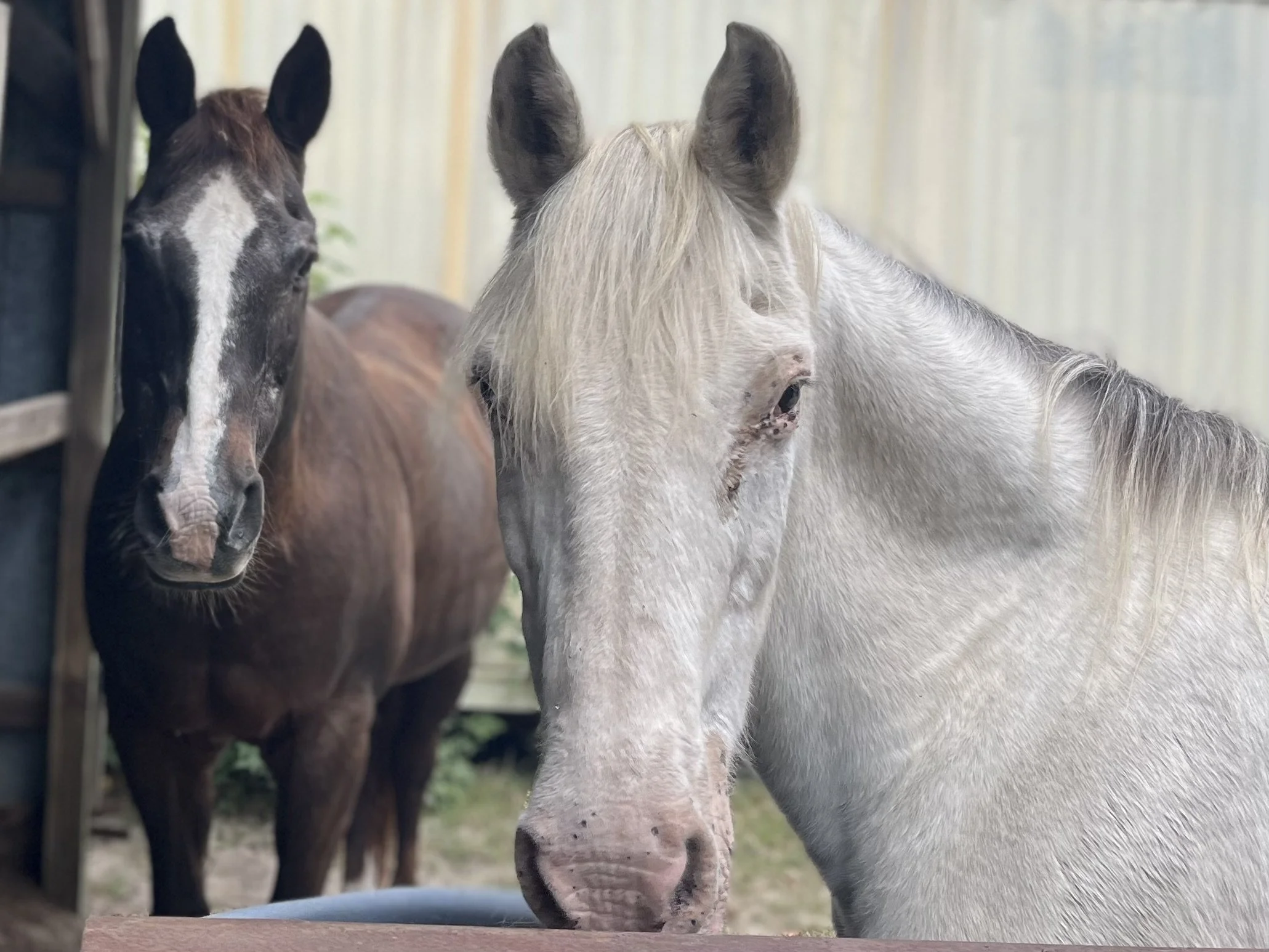
“The farm is 1,700 acres. What is not in sugarcane, we operate as a wildlife preserve. We have been restoring the cotton farm for years by planting longleaf trees to bring back habitat for the quail population and deer,” Karin explained. “We have an abundance of ponds and lakes and streams and then, of course, my mustang sanctuary - I have about 20 horses right now.”

The farm had been used for generations to grow cotton and peanuts, but over the past 20 years or so since purchasing the land, the Vonks have been working to restore the soil and create a space that invites and sustains wildlife. Using sustainable practices for growing their sugarcane is a part of that overall design.

Pesticides and herbicides are not used at all and fertilizers have been used sparingly and not for many years. 

“We have been blessed … There’s no need for them, but it’s also our principle that we do not want to use any pesticides or herbicides  … It’s a grass. It’s a very grateful crop. It’s an easy crop,” Karin said of their choice to grow without chemical inputs.


“We plant six feet apart, so in early spring the weeds will come up and the weeds are higher than the sugarcane at that point. So, it’s easy for us to scorch the weeds ... which will replenish the soil. And then by the time the summer weeds are coming, they won’t come because then the sugarcane has shaded out the soil. Summer weeds are not a problem for us. It’s sustainable, it’s organic.”


In terms of sustainability, sugarcane is a model crop. As a grass, it will naturally regrow after being cut down and is therefore self-sustaining for several years.

“The sugarcane stalk has nodes and that’s where new shoots will come out,” Karin explained. “So, part of the harvest we turn into sugarcane syrup. With the remaining harvest, the cut stalk is laid flat and (immediately) buried in a six inch row. The nodes will produce roots underground since the soil is still warm. In March, you already have a nice stalk because the root has been established.”

Replanting at the time of harvest is a method that took some time to develop. Initially the stalks were stored over winter and then planted in the spring. This not only didn’t produce good results because the canes had dried out and were less likely to take root at all, but also because it significantly reduced the growing season.


After growing cane in one area for a period of four years or so, the Vonks will plant peanuts for one to two years. This rotation allows the soil to be replenished with nitrogen which the peanuts provide and the sugarcane needs for healthy growth. Thus virtually eliminating the need for fertilizers. 


An aspect of Richland Rum that is of great importance is the complete absence of chemicals and additives. This fact, which Karin is quick to point out, makes it stand out from many other forms of alcohol and types of rum.  

“We bring it (sugarcane) from the farm in November and December and this is the only ingredient in our rum,” Karin emphasized. “Everything else that are normally in alcoholic beverages: coloring, taste enhancers, mouth feel changers, preservatives, additives - nothing. Sugar cane syrup from cane grown in Georgia is the only ingredient.”


The Vonks are committed to the single-estate approach to producing rum. They have no intention of expanding beyond the 250 acres they currently use for growing the cane. Having recently invested in a pivot system for irrigation and specialty equipment that enabled them to transition from hand-cutting the crop to using a tractor, they plan to maintain their current acreage. To this point, additional acres had been added to sugarcane production each year, but they believe they have reached the optimum size for their farm and for the rum production they wish to maintain.


By intentionally limiting the company’s growth, they understand that there may come a point where demand outstrips supply, but they are okay with that outcome. Scarcity will only serve to increase the prices.

“So be it, it becomes scarce,” Karin said. “It’s good, because the price goes up. We will not become slaves of our own success.”

It was, after all, only ever intended to be a hobby.                         

Visit www.richlandrum.com to learn more!

Recipes

Although they recommend you enjoy Richland Rum neat, here are two cocktail recipes that will be sure to warm you up this holiday season!

  • Richland Coffee

    • In a coffee mug, combine 2 oz of Richland Single Estate Old Georgia Rum and 4 oz of dark roast coffee. Add ½ oz of Richland Almost Rum Pure Cane Syrup and stir. Add thin layer of heavy cream by gently pouring over stirring spoon.

  • Richland Buttered Cider

    • Dash of Richland Almost Rum - unrefined sugar cane syrup, 4 oz. hot unfiltered apple cider, 1.5 oz. Richland Single Estate Old South Georgia Rum, Cinnamon stick, Slice of orange. RITUAL:   Slowly bring apple cider to a simmer over low heat, Put a dash of Almost Rum in a glass, Pour hot apple cider in the glass, Add Richland Rum, Add a dollop of butter, Garnish with cinnamon stick and orange slice

Editor’s Note:

For those who are familiar with our policies and coverage area, you may be wondering why we included an article on Richland Rum as it is not located here within Southeast Georgia. Richland Rum recently opened their second distillery in downtown Brunswick, bringing them squarely into our neighborhood.

Additionally, while consumers are becoming much more accustomed to seeking out sustainable and clean food options, beverages are still very much under the radar. Here we have a product that is produced in South Georgia that is not only sustainable, but is gaining a world-wide reputation for its quality as well. 

While it’s a bit of a trek to Richland from where most of us in Southeast Georgia live, the distillery is a treat to visit. 

The Richland Rum Distillery is a feast for the senses. Buildings full of history in downtown Richland have been renovated and restored, offering an attractive backdrop for tastings, events and tours. 

The aroma itself is intoxicating. Something like cotton candy dancing on a breeze of fresh cut grass and sunshine just after a rain shower has washed the air clean. Sugarcane syrup bubbles contentedly as natural yeasts work their magic - turning grass into rum.

And then, of course, there’s the tastings. If you’d rather not make the drive to Richland, the Brunswick location is open to the public for tours, tastings and shopping.